

- 25. March 2026
From Lab to Building Site: How EASI ZERo Is Proving That Sustainable Materials Can Meet Real-World Construction Demands
In this article, we interview Franziska Endres from EASI ZERo partner Sievert. She is project manager in Research & Development at Sievert, and leader of Work Package 4 in EASI ZERo: Construction products development and assembly. We hear about her experience in the EASI ZERo project, from international collaboration to real-world breakthroughs. At Sievert, Franziska Endres works with formulating and manufacturing a sprayable insulating render, made with aerogel for efficient insulation.
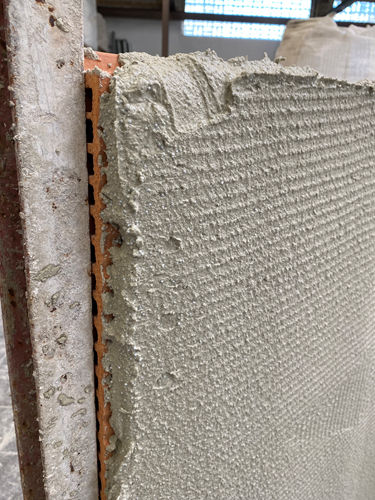
Sprayable insulating render, developed by Sievert. Photo: Sievert SE
What has been the most rewarding part of participating in EASI ZERo?
The best part of participating in the EASI ZERo project was collaborating with international project partners. What motivates me most is that we aren’t confined to the lab but are working together on systems that will later be implemented in actual buildings, thereby making a measurable contribution to reducing CO₂ emissions.
What has been the biggest win / largest breakthrough so far?
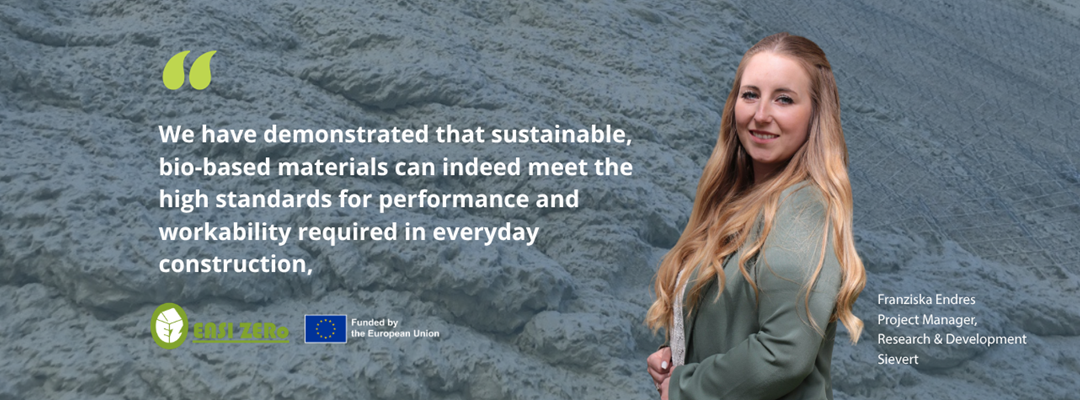
For me, the project’s greatest success is that we have demonstrated that sustainable, bio-based materials can indeed meet the high standards for performance and workability required in everyday construction, while simultaneously reducing the carbon footprint over their entire lifecycle. For me personally, it was a milestone to see that our solutions work not only in theory but also in practical applications.
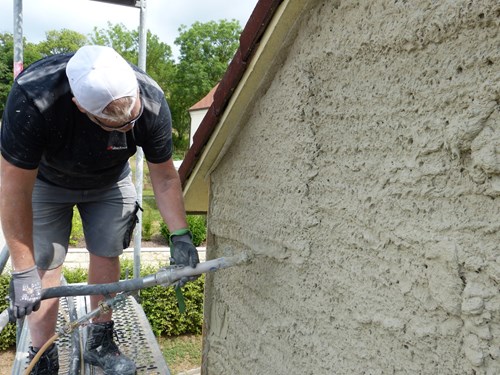
Sprayable insulation render is applied to building façade. Photo: Sievert SE
How do the materials you have developed contribute to EASI ZERo’s goals of sustainability, circularity, and performance?
The materials we co-developed with Sievert directly contribute to EASI ZERo’s core objectives: sustainability, circular economy, and performance.
- When it comes to sustainability, we rely on bio-based raw materials, thereby significantly reducing the building envelope’s carbon footprint compared to conventional solutions.
- For the circular economy, it is important to me that our materials are designed to be easily installed and dismantled, and that components can be reused or recycled.
- In terms of performance, we combine good insulation values and thermal storage capacity with high durability and practical workability.
What potential do you see for the materials to be adopted more widely in the construction industry?
I see enormous potential for the widespread use of these materials in the construction industry. On the one hand, with EASI ZERo, we are addressing a massive market: the energy-efficient retrofitting of existing buildings, which account for a large share of CO₂ emissions in Europe. On the other hand, the system is designed to be easy to install and compatible with various building types - both in retrofitting and new construction.
Visit the Sievert website here
Want to learn more about the materials being developed in EASI ZERo? Follow us on Linkedin to keep up with the latest project news, and sign up for the Final Conference in Brussels May 28th
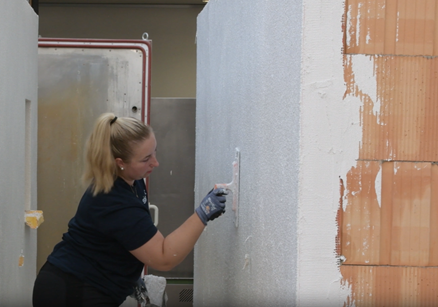
The aerogel-based insulation plaster is tested at the University of Stuttgart. Photo: University of Stuttgart